The Cayman Sandwich
The article explains how the "Cayman sandwich" has become a popular model for international venture capital because it offers tax efficiency, legal certainty, investor protection, flexibility on exits, and scalability for global businesses and investors.
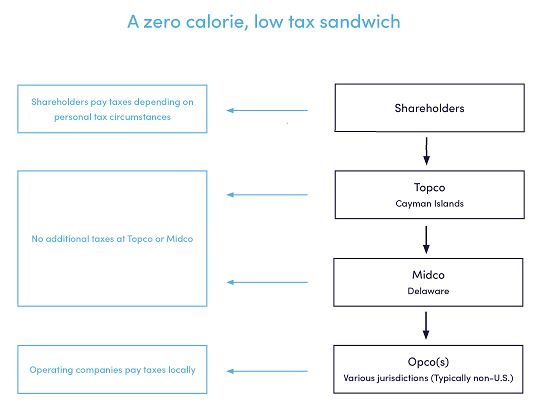
While the Cayman Islands is often heralded as the culinary capital of the Caribbean, you might be surprised to hear that its most famous sandwich offering is not featured on any local menus. Instead, the "Cayman sandwich" is a three-tiered corporate structure that utilizes a Cayman Islands exempted company as the ultimate parent, a Delaware limited liability company as an intermediate holding company, beneath which sit operating subsidiaries across relevant jurisdictions.
While use cases are potentially many and varied, the Cayman sandwich is particularly prevalent in international venture capital when founders and/or their businesses are located outside of the United States. The structure is especially popular in Latin America where it has been widely used since its introduction more than a decade ago, but its characteristics have global appeal.
Key features and advantages
In the venture capital context, the Cayman sandwich offers the following benefits for both founders and investors:
Tax efficiency
- The Delaware LLC typically files as a "pass-through" entity for U.S. tax purposes, and as a result, profits distributed by the operating companies are not subject to corporate tax in the United States.
- There is no corporate, income, capital gains, or withholding taxes payable by Cayman Islands exempted companies, so investors and founders are not subject to any additional taxes at the Cayman level.
Stable, investment-friendly legal regime
- Cayman Islands law is based on English common law, and as a British Overseas Territory, the Cayman Islands' highest court of appeal is the Judicial Committee of the Privy Council in the United Kingdom. Economically and politically stable and with a well-developed and predictable body of corporate law, the Cayman Islands is a familiar and appealing jurisdiction for both founders and investors.
- The Cayman Islands exempted company is ideally suited to act as a holding company. In many respects very similar to a Delaware C Corp (but without the corporate tax), model venture capital documents such as the popular NVCA forms can be applied to a Cayman Islands exempted company with relatively few changes. With no capital requirements, taxation, or exchange controls at the Cayman level, the Cayman Islands company can easily facilitate investment into the structure.
Flexibility on exit structuring
- The three-tiered structure gives optionality on an exit transaction, with the potential to sell the business at any of the three levels providing flexibility to structure transactions in the most tax efficient manner.
- Potential options for exits at the Cayman level include: (i) an acquisition of shares in the Cayman company (no onerous legal requirements or stamp duties) ; (ii) a statutory merger (the Cayman Islands merger regime is recognized for its speed and flexibility); or (iii) an IPO (Cayman Islands companies are frequently listed on major global exchanges, particularly in the United States).
Containment of operational liabilities
- The Cayman topco and Delaware midco interpose two layers of protection between the investors and liabilities that may arise at the operating company level. In addition to shielding investors from ordinary course liabilities incurred by the operating companies, this insulation is particularly important if the operating companies are doing business in jurisdictions with heightened geopolitical risk or where local laws and regulations may not necessarily be investor-friendly.
- The business can be easily scaled by adding additional operating companies and jurisdictions to the structure without impacting or requiring any changes at the Cayman level.
Conclusion
While not as gastronomically satisfying as a Philly cheesesteak, Cuban sandwich, or French dip, the Cayman sandwich has become the market standard structure for international venture capital and we believe it will continue to be a hugely popular option for both founders and investors going forward.
The Carey Olsen team in the Cayman Islands has extensive experience advising emerging companies and venture capital investors. In 2025, we advised on roughly US$2.3 billion worth of venture capital financings, and have acted on many of the most significant financings and exits involving a Cayman sandwich. Examples of some of our recent notable transactions can be found linked on Trevor McCabe's and Evan Stitt's website pages.