Guernsey to introduce Protected Cell Limited Partnerships
Guernsey is proposing to implement one of the most significant developments to its limited partnership regime since the Limited Partnerships (Guernsey) Law, 1995 (the "LP Law") first came into force.
The Limited Partnerships (Protected Cells) (Guernsey) (Amendment) Law, 2026 (the "Amendment Law"), if approved by the States of Guernsey in December, will introduce the Protected Cell Limited Partnership ("PCLP") — an innovative structure that brings cellular asset segregation to Guernsey's limited partnership legislation.
Guernsey was the first jurisdiction in the world to introduce protected cell companies ("PCCs"), a then unique concept which has since been copied around the world. PCLPs now bring that innovation to Guernsey limited partnerships, further expanding the range of Guernsey-based investment vehicles.
Recap: what is a Limited Partnership?
Limited partnerships are a distinct form of partnership that is particularly well-suited for use as investment vehicles.
In a classic partnership, all of the partners will typically have management and control rights and – most significantly – have personal, unlimited liability as partners.
A limited partnership, by contrast, has two types of partner:
- the "general partner", responsible for the management and control of the limited partnership. The general partner assumes unlimited liability for the debts of the limited partnership; and
- the "limited partners", who do not participate in the management of the limited partnership and whose involvement is (broadly) limited to contributing capital to the limited partnership. The limited partners (as the name suggests) enjoy limited liability status – their liability is capped at the amount they agree to commit to the limited partnership under the terms of the limited partnership agreement (their "commitment").
Due to their flexibility and tax-transparent characteristics, limited partnerships are commonly used as investment vehicles for closed-ended investment structures such as private equity and venture capital funds.
What are the benefits of a PCLP?
The flexibility of limited partnerships and limited partnership agreements means that different limited partners can hold limited partnership interests corresponding to specific assets.
Consider the scenario where a limited partnership holds two investments (A and B) and two limited partners (X and Y). Limited partner X subscribes for "Series A" limited partnership interests, which provide it with the returns of investment A only. Limited partner y subscribes for "Series B" limited partnership interests, which provide it with the returns of investment B only.
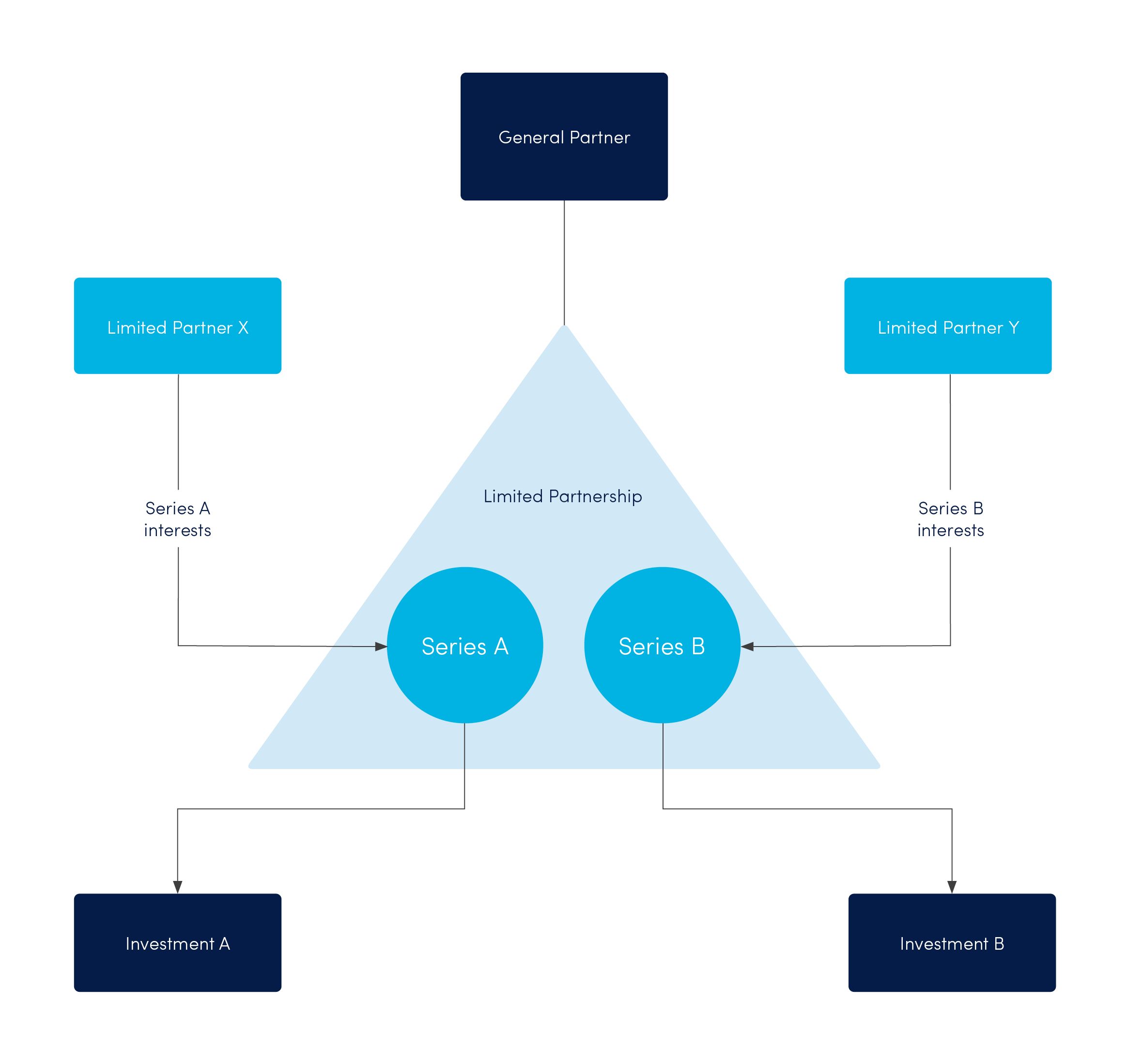
If structured correctly, the limited partnership agreement would ensure that the assets are contractually segregated. That means that any liabilities of the limited partnership which arise in connection investment A can only be satisfied from investment A (and any unpaid commitments of Series A limited partners).
Similarly, the limited partnership agreement would seek to ensure that any liabilities of the limited partnership which arise in connection investment B can only be satisfied from investment B (and any unpaid commitments of Series B limited partners).
If, however, any liabilities of the limited partnership arising from investment A could not be satisfied by the sale of investment A, creditors might seek recourse against the other assets of the limited partnership (i.e. investment B).
That would mean that limited partner Y – even though it has no exposure to investment A – might lose money due to losses incurred by investment A.
So … how would a PCLP help? A PCLP is a single limited partnership comprised of:
- a core, and
- one or more cells.
The cells are the key to the benefits of a PCLP. The proposals provide:
- that each cell of a PCLP will hold segregated cellular assets and liabilities;
- for ring‑fenced creditor recourse, meaning that assets attributed to a particular cell will be insulated from recourse by creditors of other parts of the PCLP (the assets of each cell, vis-à-vis liabilities of other cells and the core, are "protected assets"), and liabilities attributable to a specific cell may only be met from that cell’s assets and liabilities; and
- that the cells will not constitute separate partnerships or separate legal persons.
In short, a PCLP provides for statutory ringfencing, strengthening any contractual ringfencing implemented by a limited partnership agreement.
To revisit the earlier example:
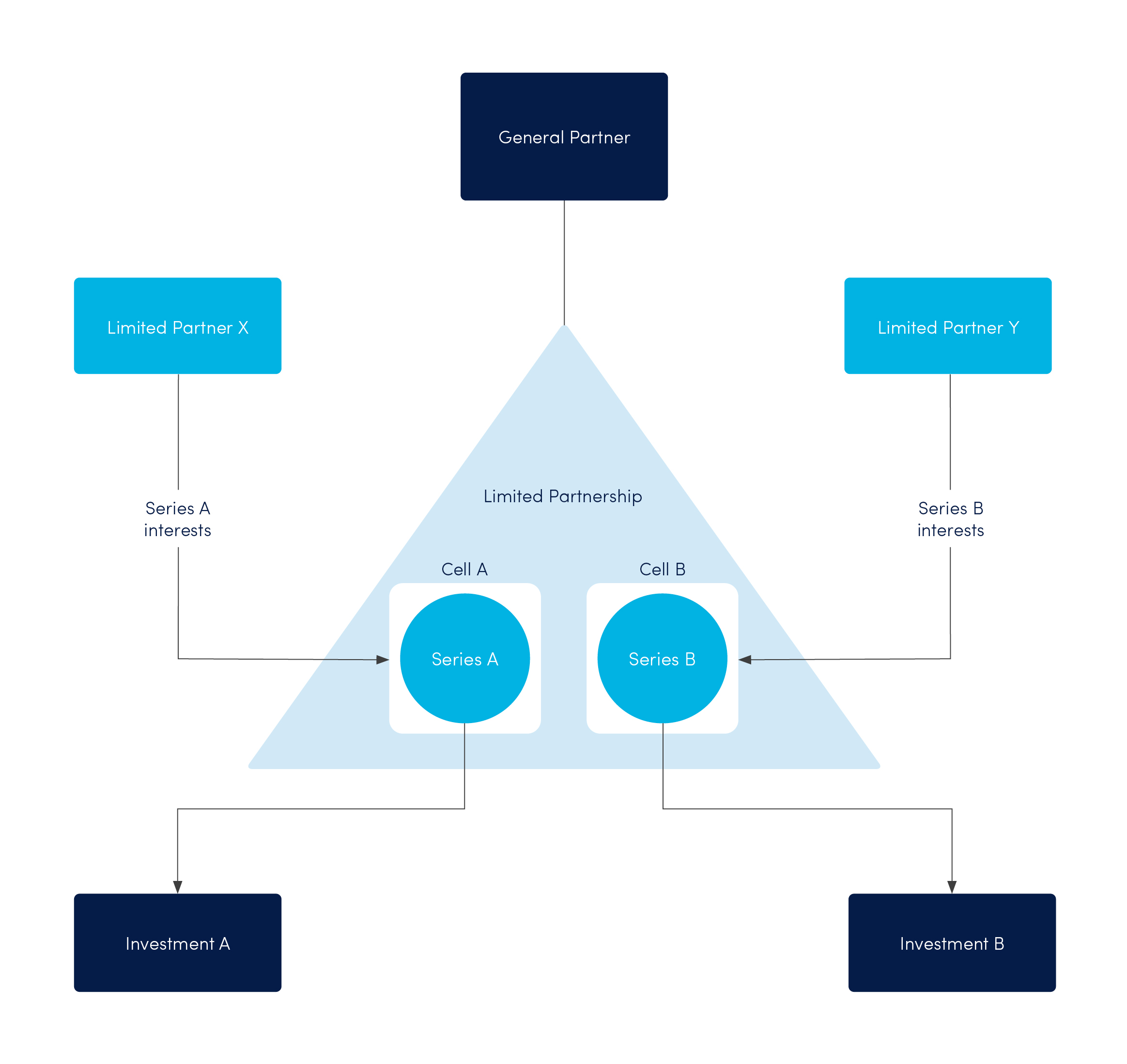
In the above diagram, investment A and investment B are now held in separate cells (cells A and B respectively). If any liabilities of the limited partnership arising from investment A could not be satisfied by the sale of investment A, it is now provided by statute that the creditors in respect of those liabilities may only claim against cell A’s assets; they could not seek recourse against the other assets of the limited partnership – the assets of cell B are "protected assets", protected by statute from any claim made by the creditor.
How are PCLPs useful in investment structures?
Because a PCLP is a single limited partnership (regardless of the number of cells), and each cell provides statutory ring-fenced creditor recourse, PCLPs can help deliver greater efficiencies to investment structuring. For example:
- co-investment partnerships, which traditionally invest alongside a main fund partnership in specific investments, will be able to be established using a single PCLP rather than a separate limited partnership for each co-investment, as is now typically the case. Investors in the main fund which wish to gain additional exposure to a specific investment will be able to subscribe for limited partnership interests in a cell of a single co-investment PCLP, which acquires further interests in the relevant asset;
- "independent sponsor" structures will be able to operate through a single PCLP. As and when new individual investments are identified, investors will be able to participate by subscribing for limited partnership interests in the relevant cell; and
- a PCLP could also constitute an "umbrella" fund vehicle, in the same way that PCCs currently do as corporate fund vehicles, with each cell forming a separate fund.
The efficiencies come from the fact that a PCLP will be a single limited partnership, needing a single initial registration. Once established, each new cell of a PCLP may be created:
- with the approval of all general partners in respect of the core; or
- in the manner provided for in the limited partnership agreement.
Upon the creation of a new cell, the Guernsey Registrar must simply be notified of the general partners responsible for that cell – a straightforward filing process.
A new cell may therefore be created in a matter of minutes.
General partners in a PCLP
A further innovation is that general partners may be admitted in respect of the core or specific cells only. The LP Law (as amended) will provide for:
- the general partner's liability to be ring‑fenced to the cell of the PCLP they manage; and
- the possibility of PCCs acting as general partners, through one or more of their own protected cells.
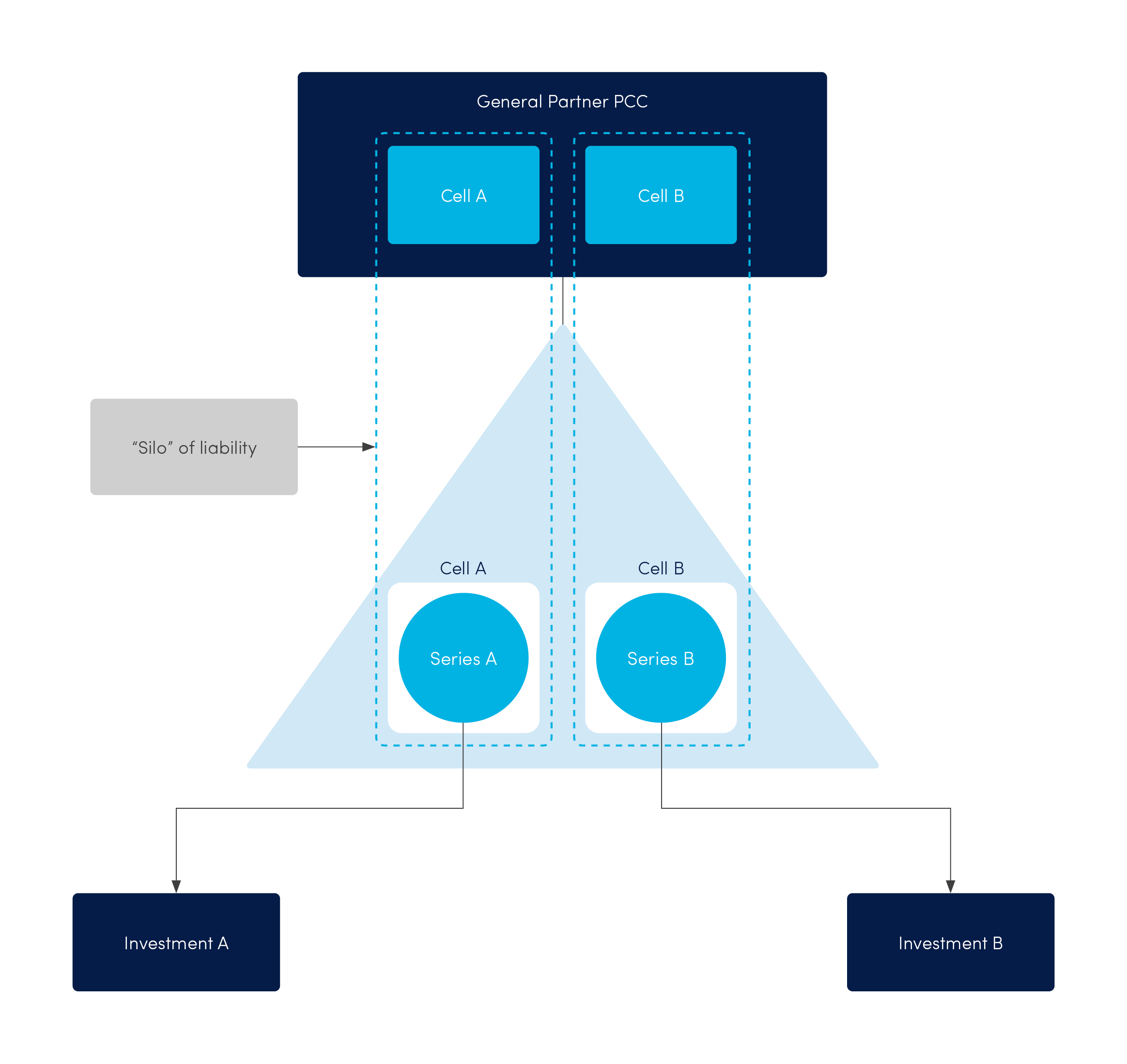
This resolves potential issues about unlimited general partner liability in a cellular structure. If a single general partner common to each cell becomes insolvent due to liabilities incurred in respect of a particular cell, this would impact upon the other cells, since they would also have an insolvent general partner.
The ability to appoint a PCC as general partner therefore enables liabilities to be even more efficiently siloed: the liability of a general partner of a cell of a PCLP can be ring-fenced within a protected cell of that general partner, avoiding general partner insolvency "contagion".
As mentioned earlier, in 1997, Guernsey was the first jurisdiction to introduce the concept of cellular companies. These have been copied in many jurisdictions and have proven to be a highly versatile vehicles. For further information on PCCs, please see our client briefing note: Protected Cell Companies in Guernsey.
Further details
This briefing note will be updated once the Amendment Law has been approved by the States of Guernsey, in order to provide further details of how PCLPs operate in practice. To ensure that you are notified when this occurs, please sign up to our circulation list here.
Guernsey as an investment domicile
The introduction of the PCLP is another important enhancement to Guernsey’s investment vehicle offering, illustrating yet again the island's innovative and forward-looking approach.
For international investors and managers familiar with protected cell concepts, the PCLP provides a highly adaptable, efficient and cost‑effective option, further enhancing Guernsey's attractiveness as an investment domicile.
Key questions on PCLPs
The FAQs below describe the regime contained in the Limited Partnerships (Protected Cells) (Guernsey) (Amendment) Law, 2026 (the "Amendment Law").
References to sections are to the Amendment Law. References to Schedule 1 are to the new Schedule 1 to the Limited Partnerships (Guernsey) Law, 1995 (the "LP Law"), inserted by section 29 and the Schedule to the Amendment Law.
Frequently asked questions
常见问题解答
Why is the introduction of PCLPs significant for Guernsey?
The PCLP combines two established features of Guernsey’s legal framework: the contractual flexibility of the limited partnership and statutory cellular segregation derived from Guernsey’s protected cell company regime.
For investment structures, this can reduce the need to establish and maintain multiple separate limited partnerships while still providing statutory separation between different assets, liabilities, investor groups and commercial arrangements.
Potential applications include "independent sponsor" (deal-by-deal) platforms, co-investment structures investing alongside main funds and incentive (carry) structures.
The result is a materially broader structuring toolkit for Guernsey. It gives managers, sponsors and investors a new way to establish scalable limited partnership platforms while retaining the familiarity and flexibility of the Guernsey limited partnership.
What is a PCLP?
A protected cell limited partnership – a PCLP – is a single Guernsey limited partnership which may establish one or more cells. Its assets and liabilities are divided between those cells and its core.
The principal benefit is statutory segregation. Subject to limited exceptions, the assets attributable to one cell are not available to meet liabilities attributable to another cell or to the core. Core assets are similarly protected from liabilities attributable to a cell.
Is each cell a separate limited partnership or legal person?
No. A PCLP is a single limited partnership. If the PCLP has elected to have legal personality, it is a single body corporate.
Creating a cell does not create a separate partnership, limited partnership or body corporate. The cells are legally segregated parts of the same PCLP, rather than separate entities. This should allow multiple segregated arrangements to be operated within a single limited partnership platform.
What is the “core” of a PCLP?
The core is the PCLP excluding its cells. Assets and liabilities which are not attributable to a particular cell will be attributed to the core; liabilities not otherwise attributable to a cell are discharged from core assets.
The core can have its own partners, contributions, limited partnership interests, assets, liabilities and business arrangements.
How does the statutory ringfencing work?
Where a liability is attributable to a particular cell, the cellular assets attributable to that cell are liable and the PCLP’s other cellular assets and core assets are protected. Conversely, a liability attributable to the core is met from core assets and not from cellular assets.
Creditors of a particular cell therefore have recourse to that cell’s assets, but do not ordinarily have recourse to the assets of another cell or to the core. This segregation is subject to the Amendment Law’s provisions on matters including recourse agreements and fraud.
Can an existing non-cellular limited partnership become a PCLP?
Yes. An existing non-cellular limited partnership may convert into a PCLP, provided it falls within an eligible category.
The conversion must be authorised by a resolution passed by at least 75% in both number and value of the limited partners. The resolution must approve the conversion, the necessary changes to the limited partnership’s name and limited partnership agreement, the creation of the cells and demarcation of the core, and the attribution of partners, contributions, limited partnership interests, assets and liabilities between the cells and core.
The conversion requires:
- the above resolution of the limited partners;
- the Commission’s written consent;
- amendments to the limited partnership agreement and the limited partnership’s name;
- at least 28 days’ prior written notice to all creditors before delivery of the conversion application to the Registrar;
- an application to the Registrar by a corporate services provider;
- a declaration of compliance signed by the general partners of the converting limited partnership and the corporate services provider; and
- the supporting documents, information and fees required by the Guernsey Registrar.
The declaration must address the solvency of the limited partnership, the core and every proposed cell, and confirm that no creditor will be unfairly prejudiced.
Does the conversion from a non-cellular limited partnership to a PCLP create a new limited partnership?
No. Conversion does not create a new partnership, limited partnership or body corporate. It does not affect the identity or continuity of the existing limited partnership.
The limited partnership’s property, rights, contracts, liabilities and legal proceedings continue following conversion, subject to the statutory provisions governing the attribution and protection of cellular and core assets.
What happens to existing creditors when a limited partnership converts?
A creditor who entered into a transaction with the non-cellular limited partnership before its conversion will retain recourse to all core and cellular assets, other than assets attributable to a cell created after conversion, unless that creditor agrees otherwise.
This protects the pre-conversion position of existing creditors and means that conversion cannot automatically be used to restrict rights which arose before the cellular structure was introduced.
Is conversion of itself a breach of contract or an event of default?
No. A conversion undertaken in accordance with the Amendment Law is not, merely because of the conversion:
- a breach of contract, confidence or other civil wrong;
- a breach of a contractual restriction on the assignment or transfer of rights or liabilities; or
- an event giving another party a termination right or other contractual remedy.
The terms of relevant contracts should nevertheless be reviewed, particularly where the conversion involves consequential operational or contractual changes beyond the conversion itself.
How is a new cell created?
A PCLP may create a cell if permitted by its limited partnership agreement.
Unless the limited partnership agreement specifies another procedure, a new cell requires the approval of all general partners in respect of the core.
Following its creation, notice must be filed with the Registrar, providing the prescribed particulars of the cell and identifying its general partners.
Is there a limit on the number of cells?
No. The law does not prescribe a maximum number of cells. A PCLP may create one or more cells, subject to its limited partnership agreement and the applicable registration requirements.
This should allow a platform to add cells as new investments, participants or strategies are introduced, without forming a separate limited partnership for every arrangement.
Can a general partner be appointed in respect of only one cell?
Yes. A general partner may be admitted in respect of the core, one or more specified cells, or a combination of them. Different cells may therefore have different general partners.
Subject to the limited partnership agreement, at least one partner must participate across the core and every cell. That person may participate as a general partner or limited partner. There is no requirement for a common general partner.
What is the liability of a cell-specific general partner?
A general partner admitted in respect of a particular cell is generally liable as a general partner only for debts attributable to that cell.
However, the general partner may also become liable in relation to another cell or the core if it participates in the conduct or management of the business attributable to that other cell or the core.
The allocation of responsibilities and authority between general partners will therefore need to be documented clearly in the limited partnership agreement.
Can a limited partner participate in more than one cell?
Yes. A limited partner may participate in respect of the core, one cell, several cells, or a combination of the core and cells.
Subject to the usual statutory exceptions, its liability is limited by reference to its contribution or commitment to the relevant cells or the core.
Must the same limited partners participate in every cell?
No. Each cell may have its own limited partners. This permits the economic participation, governance arrangements and contribution obligations for each cell to be tailored to the relevant investment or commercial arrangement.
The requirement for a common partner across the core and all cells does not mean that all limited partners must participate throughout the PCLP. The requirement (subject to the limited partnership agreement) is for at least one common partner.
Does the Amendment Law prescribe how the limited partnership agreement must be structured?
No detailed form is prescribed. The limited partnership agreement will need to address the common elements applicable to the PCLP as a whole, including its establishment and ultimate duration or termination. Beyond those common elements, the provisions applying to an individual cell can be tailored to that cell.
For example, different cells could have different:
- general partners and limited partners;
- investment strategies or underlying assets;
- contribution and drawdown arrangements;
- allocation and distribution waterfalls;
- management fees and carried-interest arrangements;
- governance and consent rights;
- transfer and withdrawal provisions; and
- cell-specific termination provisions.
The PCLP should therefore offer considerable contractual flexibility within a single statutory structure.
Can different cells have different investment and economic terms?
Yes. Subject to the common terms of the PCLP and the requirements of Guernsey law, the limited partnership agreement can establish cell-specific commercial terms.
These might include:
- investment strategies and underlying assets;
- commitments and drawdowns;
- profit allocations and distribution waterfalls;
- management fees and carried interest;
- governance and consent rights; or
- transfers, withdrawals and termination.
The Amendment Law does not prescribe the "cell specific" provisions of the limited partnership agreement. Accordingly, parties are free to have as many or as few cell-specific commercial terms as they wish.
What structures could a PCLP be used for?
Potential applications include:
- deal-by-deal fund-adjacent co-investment structures, with a separate cell for each investment;
- individual sponsor or independent sponsor transactions, with a separate cell for each acquisition;
- carried-interest and incentive arrangements, with different cells for different funds, strategies, teams or vintages;
- continuation and special-purpose investment arrangements;
- parallel investment programmes for different investor groups;
- warehousing structures, with separate cells holding different prospective investments;
- club deals and joint ventures with transaction-specific participants;
- feeder or access arrangements for different investor categories;
- separate sleeves for alternative economic, currency or hedging arrangements;
- segregated proprietary investment programmes;
- family office and private wealth investment platforms; and
- insurance, lending or other regulated structures where the relevant regulatory conditions are met.
In each case, the attraction is the ability to combine separate groups of participants and segregated pools of assets within one limited partnership framework.
Whether a PCLP is appropriate will depend on the intended legal, regulatory, tax, accounting and operational treatment.
Which limited partnerships will be eligible to become PCLPs?
The draft legislation permits PCLP status for specified regulated or administered structures. These include certain insurance licensees, authorised or registered collective investment schemes, licensees carrying on controlled investment business, lending, credit and finance licensees, and limited partnerships administered by an appropriately licensed person with a place of business in Guernsey.
Additional classes may be prescribed. In all cases, the Commission’s written consent is required to establish a PCLP.
Must a PCLP be administered in Guernsey?
An unregulated PCLP and its affairs must be administered by a qualifying licensed person with a place of business in Guernsey. The Amendment Law identifies the types of Guernsey licensee which can perform that role.
Other eligibility routes may apply where the PCLP is itself regulated or licensed under one of the specified regulatory laws.
When is Commission consent required?
Written consent of the Commission is required for:
- the registration of a new PCLP;
- the inward migration of a PCLP;
- the conversion of an existing non-cellular limited partnership into a PCLP; and
- the conversion of a PCLP back into a non-cellular limited partnership.
The Commission may impose conditions on its consent and may subsequently vary, revoke or impose further conditions.
How must cellular and core assets be maintained?
The relevant general partners must keep:
- cellular assets separate and separately identifiable from core assets; and
- the assets of each cell separate and separately identifiable from the assets of every other cell.
Assets may be held through nominees or underlying entities and may be collectively invested or managed, provided that they remain separately identifiable.
Robust attribution, banking, custody, accounting and record-keeping arrangements will therefore be central to operating a PCLP.
Can separate accounts be prepared for each cell?
Yes. A PCLP may prepare separate accounts for each cell and for the core instead of preparing accounts for the PCLP as a whole. Those separate accounts must otherwise comply with the accounting requirements of the LP Law.
The statutory accounting requirements apply to those separate accounts with the necessary adaptations. Specified audit and related provisions are also adapted where separate accounts are prepared.
Can assets of different cells be invested or managed together?
Yes. The general partners may permit cellular and core assets, or a combination of them, to be collectively invested or collectively managed.
The statutory segregation is not lost merely because assets are managed collectively, provided that the assets attributable to each cell and to the core remain separately identifiable. Careful record keeping will be essential where pooled custody or investment arrangements are used.
Can assets or liabilities be transferred between cells?
Yes. A PCLP may implement internal arrangements involving dealings, transfers, dispositions or attributions:
- between cells;
- between a cell and the core;
- between the PCLP and the core; or
- between the PCLP and a cell.
The PCLP must make the necessary adjustments to its accounting records.
The Royal Court of Guernsey may also make orders concerning the implementation, enforcement, attribution, preservation or recovery of assets affected by an arrangement.
Can a creditor agree to have recourse to otherwise protected assets?
Yes. A PCLP and a third party may enter into a written “recourse agreement” under which specified protected assets are made available in respect of a liability.
Before authorising the agreement, each relevant general partner must declare that it reasonably believes no creditor will be unfairly prejudiced. Unless the limited partnership agreement provides otherwise, the declaration must also address approval by statutory resolution of the limited partners whose cell or core assets are being exposed. That requires at least 75% in both number and value of those limited partners. The declaration can be inspected by creditors and limited partners, subject to reasonable restrictions.
What information must be given to a person contracting with a PCLP?
A general partner transacting for a PCLP must inform the counterparty that it is dealing with a PCLP. It must also:
- identify the cell concerned or state that the transaction relates to the core; and
- identify the general partners of that cell or the core.
Failure to provide the required information can result in personal liability for the relevant general partners and, where the general partner is a legal person, its officers.
Transaction documents, signature blocks and operating procedures will therefore need to identify the relevant PCLP capacity accurately.
Will the limited partners of one cell be able to identify the limited partners of another cell?
No. Unless the limited partnership agreement provides otherwise, the limited partners of one cell will not be able to identify the limited partners of another cell through their statutory access rights merely because they are limited partners of the PCLP.
This provides a useful degree of commercial confidentiality between separate investor groups. Disclosure could still be required under the limited partnership agreement, applicable law, regulation, court process or another binding obligation.
Can a limited partner receive accounts relating only to its own cell?
Yes. The limited partnership agreement may provide that a limited partner of a cell who is not also a limited partner of the core receives only the parts of the accounting records, accounts and auditors’ report relating to that cell.
Similarly, a limited partner of the core which is not a limited partner of any cell may receive only the information relating to the core.
These restrictions are contractual options, not automatic rules. Information rights should be checked carefully where an investor participates in multiple cells or also in the core.
What happens if a cell becomes insolvent?
The Royal Court may make a receivership order where the assets attributable to a cell, together with any assets available under a recourse agreement, are or are likely to be insufficient to discharge the claims of that cell’s creditors.
A receivership order can apply to one or more cells without automatically placing the entire PCLP into winding up.
Does the insolvency of one cell make the entire PCLP insolvent?
No. The Amendment Law provides for a cell-specific receivership process.
The effect is that financial distress can be addressed at cell level while preserving the other cells and the core, subject to the circumstances of the PCLP and any applicable recourse agreements, security rights or wider insolvency proceedings.
Who can apply for a receivership order?
An application may be made by:
- the PCLP;
- the general partners of the core or the affected cell;
- a creditor in respect of the affected cell;
- the Commission; or
- another interested or affected person with the leave of the Royal Court.
Notice must be served on the general partners of the core and relevant cell, the Commission and anyone else as directed by the Royal Court. They must have an opportunity to make representations.
Can a PCLP convert back into a conventional limited partnership?
Yes. A PCLP may convert into a non-cellular limited partnership with the Commission’s consent and the required limited partnership resolution, creditor notices, solvency confirmations and Registrar filings.
On conversion, the cells and core are dissolved as segregated parts of the structure, and their partners, contributions, limited partnership interests, assets and liabilities are re-attributed to the non-cellular limited partnership. The identity and continuity of the limited partnership are preserved.
Importantly, creditors in respect of pre-conversion transactions have recourse to all limited partnership assets for liabilities under those transactions unless they agree otherwise. The former cell ringfences do not survive as the statutory default.
What name must a PCLP use?
The name must contain “Protected Cell Limited Partnership”, “P.C.L.P.” or “PCLP”, as well as adhering to the other applicable naming requirements of the LP Law.
The register and registration particulars must also identify its cellular status and the cells or core in respect of which each general partner acts.
Key Contacts主要联系人

Annette Alexander
Annette Alexander
+44 (0)1481 732067
Email Annette
电邮 Annette Alexander

Christopher Anderson
Christopher Anderson
+44 (0)1481 741537
Email Christopher
电邮 Christopher Anderson

Matthew Brehaut
Matthew Brehaut
+44 (0)20 7614 5620
Email Matthew
电邮 Matthew Brehaut

Tom Carey
Tom Carey
+44 (0)1481 741559
Email Tom
电邮 Tom Carey

David Crosland
David Crosland
+44 (0)1481 741556
Email David
电邮 David Crosland

Rachel de la Haye
Rachel de la Haye
+44 (0)1481 741506
Email Rachel
电邮 Rachel de la Haye

Tony Lane
Tony Lane
+44 (0)1481 732086
Email Tony
电邮 Tony Lane

Ben Morgan
Ben Morgan
+44 (0)1481 741557
Email Ben
电邮 Ben Morgan

Kim Paiva
+44 (0)1481 732057
Email Kim
电邮