Guernsey to introduce Protected Cell Limited Partnerships
Guernsey is proposing to implement one of the most significant developments to its limited partnership regime since the Limited Partnerships (Guernsey) Law, 1995 (the "LP Law") first came into force.
The Limited Partnerships (Protected Cells) (Guernsey) (Amendment) Law, 2026 (the "Amendment Law"), if approved by the States of Guernsey in December, will introduce the Protected Cell Limited Partnership ("PCLP") — an innovative structure that brings cellular asset segregation to Guernsey's limited partnership legislation.
Guernsey was the first jurisdiction in the world to introduce protected cell companies ("PCCs"), a then unique concept which has since been copied around the world. PCLPs now bring that innovation to Guernsey limited partnerships, further expanding the range of Guernsey-based investment vehicles.
Recap: what is a Limited Partnership?
Limited partnerships are a distinct form of partnership that is particularly well-suited for use as investment vehicles.
In a classic partnership, all of the partners will typically have management and control rights and – most significantly – have personal, unlimited liability as partners.
A limited partnership, by contrast, has two types of partner:
- the "general partner", responsible for the management and control of the limited partnership. The general partner assumes unlimited liability for the debts of the limited partnership; and
- the "limited partners", who do not participate in the management of the limited partnership and whose involvement is (broadly) limited to contributing capital to the limited partnership. The limited partners (as the name suggests) enjoy limited liability status – their liability is capped at the amount they agree to commit to the limited partnership under the terms of the limited partnership agreement (their "commitment").
Due to their flexibility and tax-transparent characteristics, limited partnerships are commonly used as investment vehicles for closed-ended investment structures such as private equity and venture capital funds.
What are the benefits of a PCLP?
The flexibility of limited partnerships and limited partnership agreements means that different limited partners can hold limited partnership interests corresponding to specific assets.
Consider the scenario where a limited partnership holds two investments (A and B) and two limited partners (X and Y). Limited partner X subscribes for "Series A" limited partnership interests, which provide it with the returns of investment A only. Limited partner y subscribes for "Series B" limited partnership interests, which provide it with the returns of investment B only.
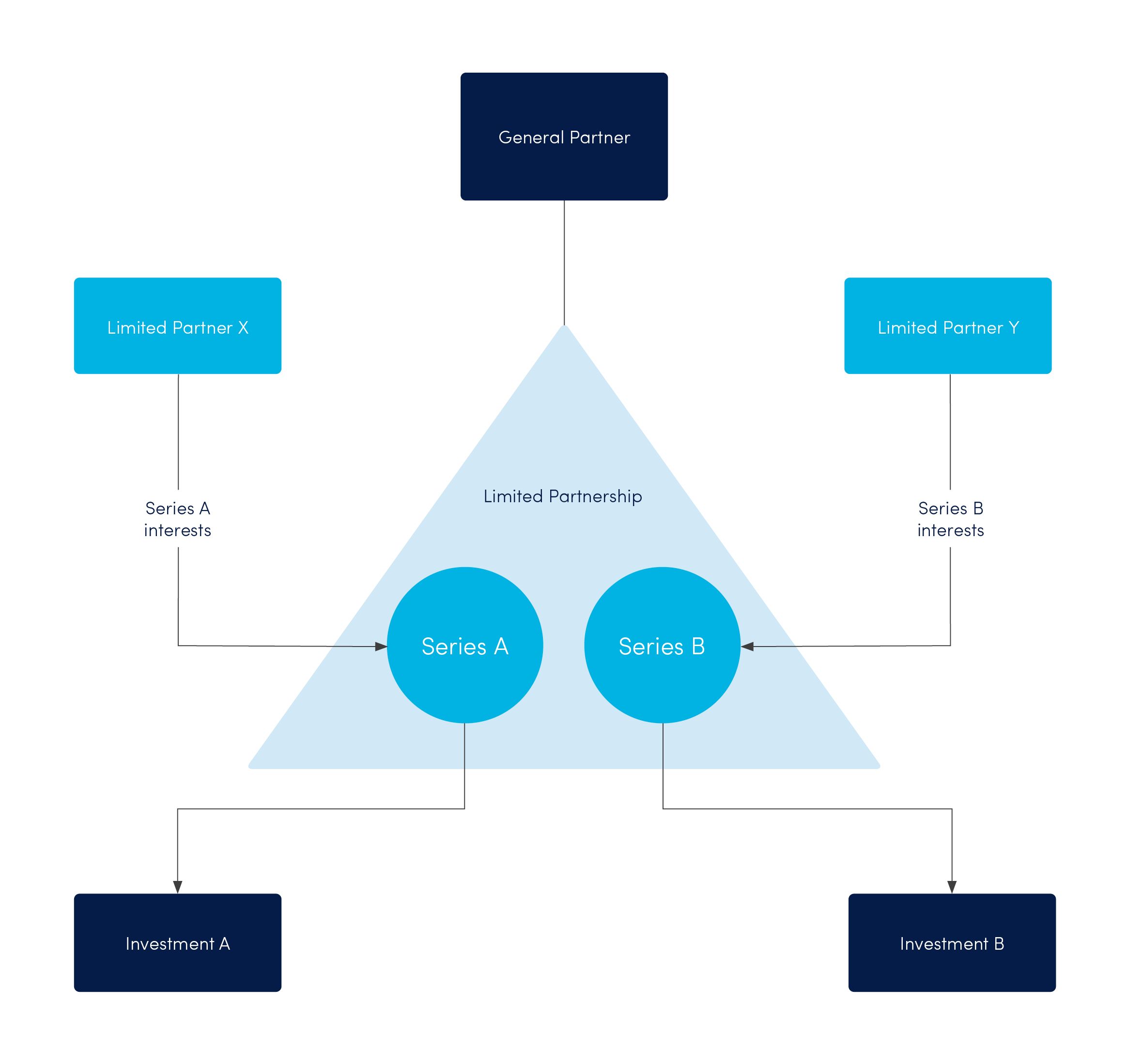
If structured correctly, the limited partnership agreement would ensure that the assets are contractually segregated. That means that any liabilities of the limited partnership which arise in connection investment A can only be satisfied from investment A (and any unpaid commitments of Series A limited partners).
Similarly, the limited partnership agreement would seek to ensure that any liabilities of the limited partnership which arise in connection investment B can only be satisfied from investment B (and any unpaid commitments of Series B limited partners).
If, however, any liabilities of the limited partnership arising from investment A could not be satisfied by the sale of investment A, creditors might seek recourse against the other assets of the limited partnership (i.e. investment B).
That would mean that limited partner Y – even though it has no exposure to investment A – might lose money due to losses incurred by investment A.
So … how would a PCLP help? A PCLP is a single limited partnership comprised of:
- a core, and
- one or more cells.
The cells are the key to the benefits of a PCLP. The proposals provide:
- that each cell of a PCLP will hold segregated cellular assets and liabilities;
- for ring‑fenced creditor recourse, meaning that assets attributed to a particular cell will be insulated from recourse by creditors of other parts of the PCLP (the assets of each cell, vis-à-vis liabilities of other cells and the core, are "protected assets"), and liabilities attributable to a specific cell may only be met from that cell’s assets and liabilities; and
- that the cells will not constitute separate partnerships or separate legal persons.
In short, a PCLP provides for statutory ringfencing, strengthening any contractual ringfencing implemented by a limited partnership agreement.
To revisit the earlier example:
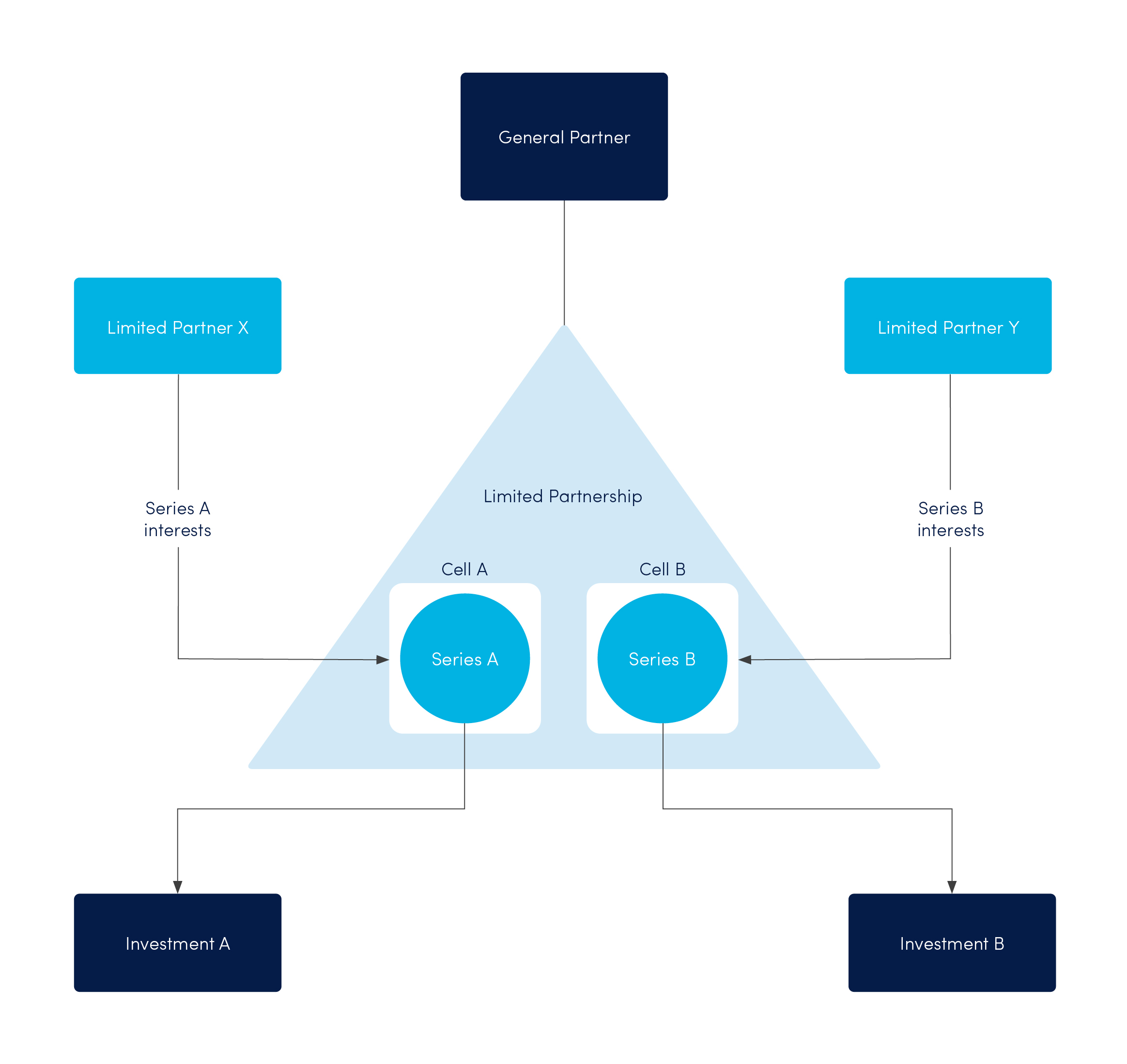
In the above diagram, investment A and investment B are now held in separate cells (cells A and B respectively). If any liabilities of the limited partnership arising from investment A could not be satisfied by the sale of investment A, it is now provided by statute that the creditors in respect of those liabilities may only claim against cell A’s assets; they could not seek recourse against the other assets of the limited partnership – the assets of cell B are "protected assets", protected by statute from any claim made by the creditor.
How are PCLPs useful in investment structures?
Because a PCLP is a single limited partnership (regardless of the number of cells), and each cell provides statutory ring-fenced creditor recourse, PCLPs can help deliver greater efficiencies to investment structuring. For example:
- co-investment partnerships, which traditionally invest alongside a main fund partnership in specific investments, will be able to be established using a single PCLP rather than a separate limited partnership for each co-investment, as is now typically the case. Investors in the main fund which wish to gain additional exposure to a specific investment will be able to subscribe for limited partnership interests in a cell of a single co-investment PCLP, which acquires further interests in the relevant asset;
- "independent sponsor" structures will be able to operate through a single PCLP. As and when new individual investments are identified, investors will be able to participate by subscribing for limited partnership interests in the relevant cell; and
- a PCLP could also constitute an "umbrella" fund vehicle, in the same way that PCCs currently do as corporate fund vehicles, with each cell forming a separate fund.
The efficiencies come from the fact that a PCLP will be a single limited partnership, needing a single initial registration. Once established, each new cell of a PCLP may be created:
- with the approval of all general partners in respect of the core; or
- in the manner provided for in the limited partnership agreement.
Upon the creation of a new cell, the Guernsey Registrar must simply be notified of the general partners responsible for that cell – a straightforward filing process.
A new cell may therefore be created in a matter of minutes.
General partners in a PCLP
A further innovation is that general partners may be admitted in respect of the core or specific cells only. The LP Law (as amended) will provide for:
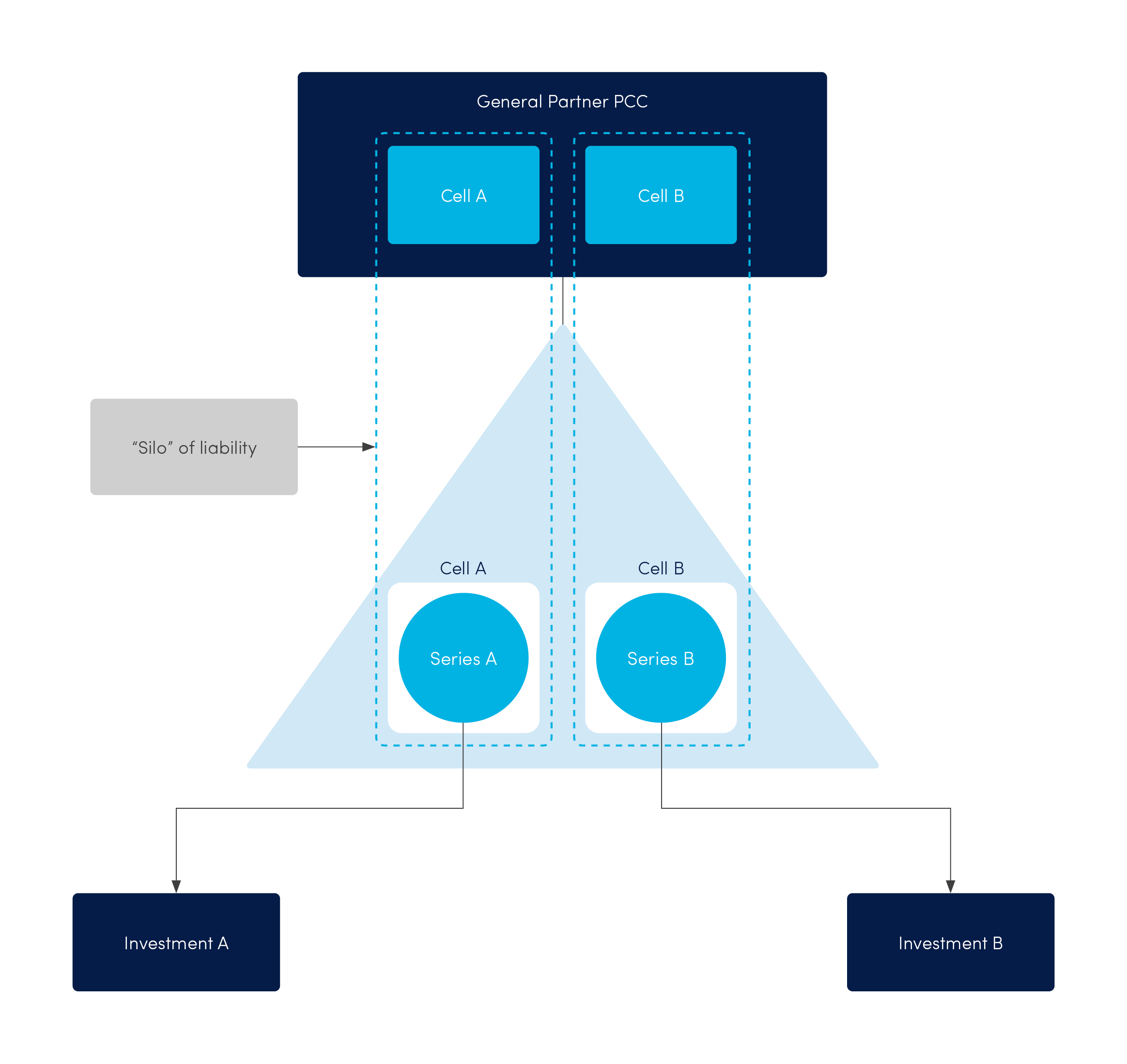
- the general partner's liability to be ring‑fenced to the cell of the PCLP they manage; and
- the possibility of PCCs acting as general partners, through one or more of their own protected cells.
This resolves potential issues about unlimited general partner liability in a cellular structure. If a single general partner common to each cell becomes insolvent due to liabilities incurred in respect of a particular cell, this would impact upon the other cells, since they would also have an insolvent general partner.
The ability to appoint a PCC as general partner therefore enables liabilities to be even more efficiently siloed: the liability of a general partner of a cell of a PCLP can be ring-fenced within a protected cell of that general partner, avoiding general partner insolvency "contagion".
As mentioned earlier, in 1997, Guernsey was the first jurisdiction to introduce the concept of cellular companies. These have been copied in many jurisdictions and have proven to be a highly versatile vehicles. For further information on PCCs, please see our client briefing note: Protected Cell Companies in Guernsey.
Further details
This briefing note will be updated once the Amendment Law has been approved by the States of Guernsey, in order to provide further details of how PCLPs operate in practice. To ensure that you are notified when this occurs, please sign up to our circulation list here.
Guernsey as an investment domicile
The introduction of the PCLP is another important enhancement to Guernsey’s investment vehicle offering, illustrating yet again the island's innovative and forward-looking approach.
For international investors and managers familiar with protected cell concepts, the PCLP provides a highly adaptable, efficient and cost‑effective option, further enhancing Guernsey's attractiveness as an investment domicile.
Key Contacts主要联系人

Annette Alexander
Annette Alexander
+44 (0)1481 732067
Email Annette
电邮 Annette Alexander

Christopher Anderson
Christopher Anderson
+44 (0)1481 741537
Email Christopher
电邮 Christopher Anderson

Matthew Brehaut
Matthew Brehaut
+44 (0)20 7614 5620
Email Matthew
电邮 Matthew Brehaut

Tom Carey
Tom Carey
+44 (0)1481 741559
Email Tom
电邮 Tom Carey

David Crosland
David Crosland
+44 (0)1481 741556
Email David
电邮 David Crosland

Rachel de la Haye
Rachel de la Haye
+44 (0)1481 741506
Email Rachel
电邮 Rachel de la Haye

Tony Lane
Tony Lane
+44 (0)1481 732086
Email Tony
电邮 Tony Lane

Ben Morgan
Ben Morgan
+44 (0)1481 741557
Email Ben
电邮 Ben Morgan

Kim Paiva
+44 (0)1481 732057
Email Kim
电邮